

Every parent starts out blissfully unaware.
Maybe you're the parent who thinks your kid "sleeps great," even though they're having attention issues, mouth breathing or snoring. Or the parent who says your kid's eating is fine, even though they're picky and only eat certain foods.
I've been there too. Looking back on my experiences when my older daughter was a baby, I now see all the signs I missed then.
If you're reading this, you've probably moved past blissfully unaware. Maybe just a little, maybe a lot. Read through the points below and see which one sounds most like you.
In this post, you'll learn:
5 places parents often find themselves on the airway journey
What tends to help at each one
Where Breathe, Sleep, Eat can support you, wherever you are
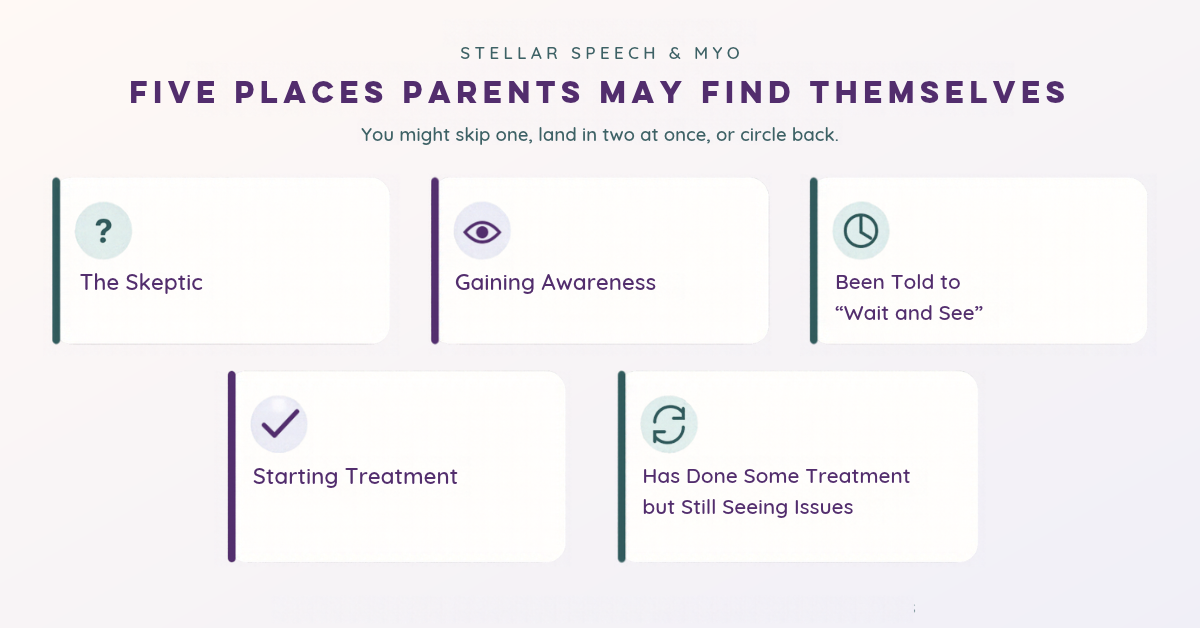
The Skeptic
This is someone who has started to see these things on social media but isn't totally sure it's "real."
If that's you, I understand. This seems like a new way of thinking, but it's really not new. It's just looking at it in a different way.
We've accepted a lot of these things as just normal parts of development, growing and aging, and things that just everyone does. But what if we start asking, "Why are these things so common, and why is no one mentioning it? How can I help everyone function at the best that they can instead of just at the bare minimum?"
In the guide: Module 1, Common Doesn't Mean Normal.
Gaining Awareness
At this point, you're starting to see all of these different signs. You're starting to understand why it's important and what you need to do.
You're asking, "Who do I need to see? What are my next steps?" You might be trying to explain it to your spouse or to friends.
What helps here is finding a provider who can corroborate what you are seeing with evaluation results and some more information. (You can get my Finding a Provider Freebie here)
In the guide: Module 3, Quality Sleep and What It Means for Kids.
Been Told to "Wait and See"
Maybe you brought up your concerns and were told to wait and see.
You may be feeling that maybe you don't actually need to worry about this. Maybe it's not actually a problem or a big deal, or maybe they will grow out of it.
Some parents understandably like to live in this phase. You may be relieved that this isn't a problem.
What helps here is someone to validate your instincts, and learning more about why wait and see isn't a good treatment approach.
In the guide: Module 7, Your Child's Roadmap.
Starting Treatment
You may be feeling relieved that you finally have a plan and are starting to treat something. But you may also be overwhelmed by all the steps that need to happen, and worried about what happens if it doesn't work.
Two things help a lot here. The first is hearing from other patients or parents who have already been there and seen improvements. The second is having a myofunctional therapist or other therapist who can point out the progress over time that we don't always notice when we are with our kids all the time.
In the guide: Module 5, Swallowing, Tongue Thrust and Picky Eating.
Has Done Some Treatment but Still Seeing Issues
You've put in the work, and things still aren't where you hoped. You may be feeling disappointed and confused about what to do next. You may start to doubt your instincts or the treatments.
Depending on what you've already tried, you may benefit from a new or different approach, a fresh angle or additional resources.
In the guide: Module 6, Myofunctional Therapy: What It Is and How It Helps.
Wherever You Are Right Now
Not every parent goes through every one of these points, or in this order. You might skip one, land in two at once, or circle back.
That's why I created Breathe, Sleep, Eat: The Parent's Guide to Connecting the Dots. The guide really is a great companion to help support your kid's airway journey, whether you are in the skeptic phase, the gaining awareness phase or the starting treatment phase.
It's $67 for everything, with instant lifetime access. The modules are short (5 to 15 minutes each), so you can fit them in when you have a few minutes. It's education, not therapy, so it's a great place to start understanding what's going on.

Bonus for November: Join by November 30 and you'll get access to a live Q&A with me on Wednesday, December 2 at 8:30 pm ET. You can send in your questions ahead of time, and everyone gets the recording.
