

“I just can’t believe he’s been in speech therapy for years and had tonsils/adenoids removed and no one ever mentioned this.”
I hear some version of this in new evals.
If your child's ENT or pediatrician has brought up taking out their tonsils and adenoids, you probably have a lot of questions. Maybe you're relieved there's finally a plan. Maybe you're nervous about surgery. Maybe both.
Taking out tonsils and adenoids can be truly necessary for many kids, and it can provide big improvements with mouth breathing. However, it's only one piece of the puzzle.
This post walks through what I want every parent to know, and do, before their child's tonsils and adenoids come out.
In this post, you'll learn:
Why removing tonsils and adenoids is only one piece of the puzzle
4 things to do before surgery
What to keep in mind if you're hoping to avoid surgery
Want an easy way to keep track of how your child is sleeping? Grab my free Sleep Observation Kit.
Why Removal Is Only One Piece of the Puzzle
Enlarged tonsils and adenoids can limit airflow through the nose. When that happens, a lot of kids start breathing through their mouths because it's the easier option. Taking them out can open things up, and for many kids it makes a real difference.
The problem is it doesn't always retrain the muscles or break the mouth breathing habit.
Many kids can be habitual mouth breathers, so they already have a habit of mouth breathing, even when they can breathe through their nose. If your child has been breathing through their mouth for months or years, that's the pattern their body knows. Making more room doesn't automatically change it.
It also doesn't solve any of the low tongue resting posture or improper swallow that may be happening as well. The tongue should rest at the roof of the mouth. When it sits low, it affects how a child breathes, swallows and even how their palate develops, and surgery doesn't change where the tongue rests.
Research backs this up.
A 2026 systematic review in the European Archives of Oto-Rhino-Laryngology found that kids who kept mouth breathing after tonsil and adenoid surgery had significantly higher apnea-hypopnea index (AHI) scores than kids who moved to nasal breathing. AHI measures how often breathing pauses or gets shallow during sleep. The surgery helped, but the mouth breathing that stayed behind still mattered.
It's important to treat tonsils and adenoids with a team approach because they can also grow back if habits and muscle patterns aren't reestablished.
So what can you do before surgery? Here are the 4 steps I walk parents through.
Step 1: Ask Why They're Enlarged in the First Place
Start asking why they are enlarged in the first place.
Enlarged tonsils and adenoids are a sign that something is going on. Before surgery, it's worth asking your child's providers what they think is driving it, and whether there's anything to look into first.
Step 2: Look at What Could Be Contributing
Determine if you need to see an allergist or make any other changes that could be contributing to the enlarged tonsils and adenoids.
That can include environmental factors like mold, diet factors and food intolerances. Anything that can contribute to chronic enlargement of the tissues is worth looking at, whether or not your child ends up having surgery.
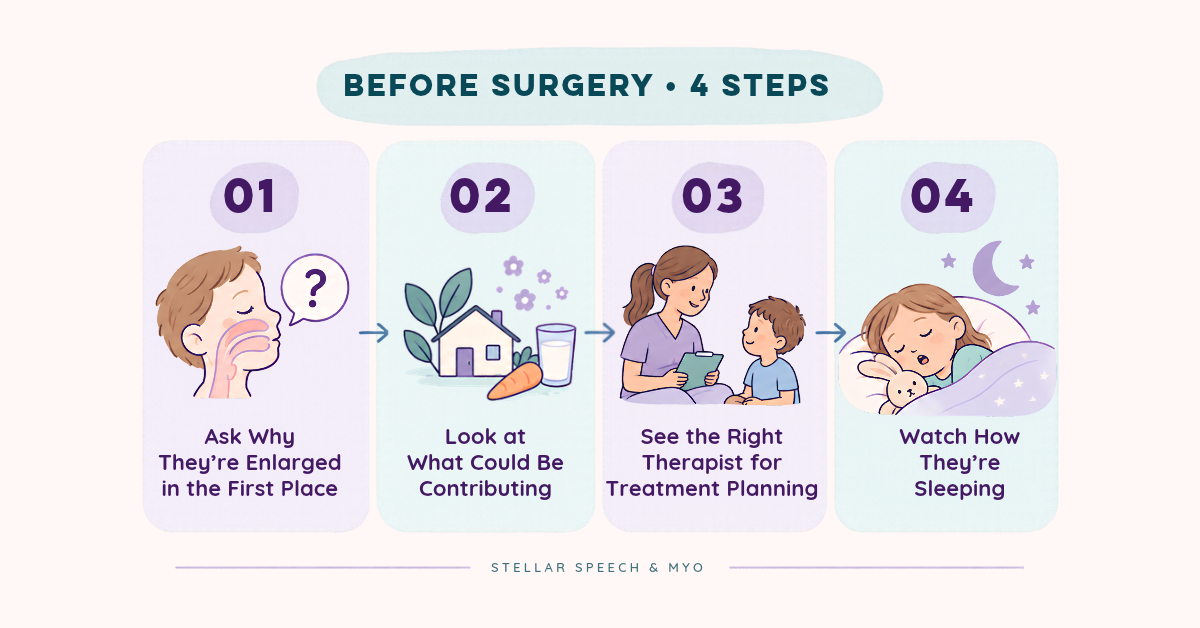
Step 3: See the Right Therapist for Treatment Planning
Ideally, see either a trained SLP for younger kids or a myofunctional therapist for older kids to determine treatment planning from a therapeutic muscle standpoint. SLPs are able to do oral motor therapy with children of any age. Other myofunctional therapists may start working with children around age 4, but it can depend.
A therapist will look at how your child breathes, where their tongue rests and how they swallow. Seeing them before surgery means you go in with a plan for the muscle side of things, instead of finding out later that the habits are still there.
This is what a team approach looks like in real life: the ENT addresses the tissue, and therapy addresses the function.
Step 4: Watch How They're Sleeping
They should also be observing and paying attention to how their kids are sleeping.
Look for mouth breathing, tossing and turning, and snoring. Even if your child sleeps through the night, these signs matter. I would argue that any kid who mouth breathes at night is actually not sleeping well at all.
Writing down what you see gives your child's providers more to work with. It also gives you something to compare to after surgery or therapy, so you can see what has changed and what hasn't.

My free Sleep Observation Kit makes this easy.
If You're Hoping to Avoid Surgery
Many clients tell me they've been told their kids need tonsils or adenoids removed and are trying to avoid surgery by going other routes.
I get why you may want to avoid surgery. I have seen some families have success with things like functional medicine or naturopathy.
But I also want to be honest with you: we can only work around it so much. If the tonsils and adenoids aren't getting smaller, therapy and expansion, etc., are going to have limits.
Whichever route you take, keep watching how your child sleeps and keep your team talking to each other.
Your Before-Surgery Checklist
☐ Ask why the tonsils and adenoids are enlarged in the first place
☐ Look at what could be contributing, like allergies, mold, diet or food intolerances
☐ See a trained SLP (younger kids) or a myofunctional therapist (older kids) for treatment planning
☐ Watch how your child is sleeping
The Bottom Line
Taking out tonsils and adenoids can be a big, helpful step for a lot of kids. It's just not the whole picture. When you look at why they're enlarged, what's contributing, how your child's muscles are working and how they're sleeping, you give that surgery the best chance of leading to lasting change.
Start with sleep. Download my free Sleep Observation Kit and start noticing what your child's nights really look like.
💬 Have a question about your child's tonsils or adenoids? Leave it in the comments. I read every one.
